
Window Treatment Ideas That Do More Than Cover the Glass
If you're searching for window treatment ideas, you're probably staring at a bare window trying to solve three problems at once: light, privacy, and style. The right treatment handles all three without you having to compromise on any of them. Here's how to think through the options so the window ends up looking finished, not just covered.

Start With What the Window Actually Needs to Do
Before you fall for a fabric or a color, get clear on the job the window has to perform. A west-facing living room that floods with afternoon sun needs real light control, not just a decorative layer. A street-facing bedroom window needs privacy after dark without feeling boxed in during the day. And a window with a view worth protecting, whether that's a hillside, a garden, or the ocean, deserves a treatment that can pull fully out of the way when you want the view to be the star.
Once you know the job, the style decision gets a lot easier.
Choose the Right Treatment for the Job
Drapery for Softness and a Finished Look
Nothing frames a window quite like custom drapery. Flowing panels add height, texture, and warmth to a room in a way that hard treatments can't match, and they can be layered over shades or shutters for both function and polish. Drapery is also the easiest treatment to tailor to a specific room. A heavier fabric adds insulation and drama to a formal living room, while a sheer panel filters light and softens a sunroom without blocking it out entirely. If you're weighing fabrics or hardware, our custom drapery work covers everything from the panel itself to the finials and holdbacks that finish the look.
Shades for Clean Lines and Everyday Function
Cellular and roman shades are the workhorses of window treatments. They tuck neatly into a window frame, offer precise light control, and suit a more modern or minimal aesthetic than drapery does. Solar shades in particular are worth considering for rooms with strong glare or UV exposure, since they cut heat and protect furniture without sacrificing the view.
Shutters for Durability and Ventilation
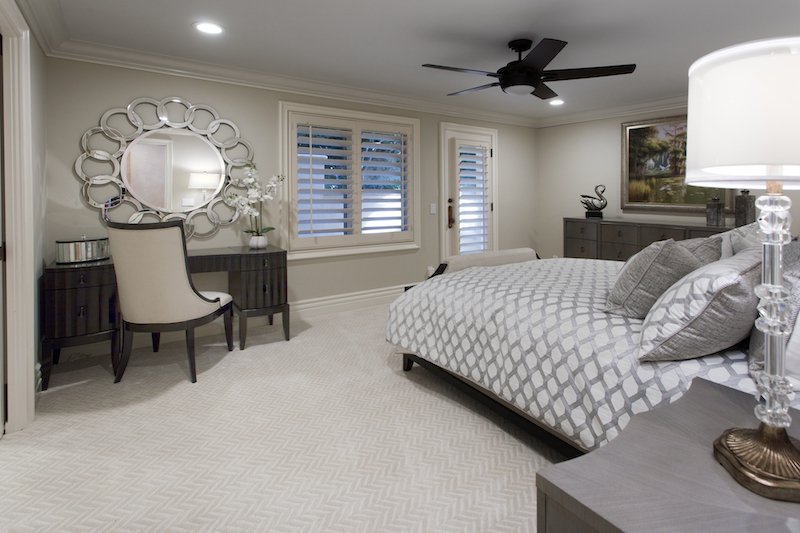
Plantation shutters hold up better than almost any other treatment, and they let you dial in exactly how much light and airflow you want with a simple tilt of the louvers. For coastal homes especially, a composite shutter resists humidity and salt air far better than solid wood, which makes it a smart long-term choice for a primary residence or a vacation property.
Match Fabric and Color to the Room, Not Just the Trend
Warm neutrals are having a moment right now: sand, cream, oat, and soft clay tones that ground a room without competing with the furniture. Misty blues and lavender-grays work well as a lighter option, especially in sheers or light-filtering shades. If you want to bring in more personality, a jewel tone like emerald or navy can work beautifully in a smaller dose, such as a patterned valance or drapery in a room that can handle the contrast.
The fabric matters as much as the color. A treatment that doesn't relate to the rest of the room's textures, whether that's the upholstery, the rug, or the furniture finishes, will always feel like it was chosen separately instead of designed together. If you're furnishing the room at the same time, our furniture showroom is a good place to pull fabric and finish ideas that pair naturally with your window treatment choice.
Layering for a More Custom Result
Some of the best-looking windows use more than one treatment at once. Pairing shutters or shades with drapery gives you the function of a hard treatment and the softness of fabric in the same window, plus more flexibility for controlling light throughout the day. It also tends to read as more intentional and higher-end than a single treatment on its own, since it shows the window was designed rather than just dressed.
Common Mistakes to Avoid
The most frequent misstep is undersizing the treatment. Drapery panels that are too narrow or too short read as an afterthought rather than a design choice, and hanging the rod too close to the window frame makes the whole wall feel smaller than it is. Mismatched hardware finishes are another easy trap. If your drapery rings, tiebacks, or shutter frames don't relate to the metal finishes elsewhere in the room, it will always look slightly off, even if the fabric itself is beautiful.
Bringing It All Together
The best window treatment ideas start with function, then layer in the fabric, color, and hardware that make the room feel finished. If you'd rather have a design eye on the fabric and proportions before you commit, our interior design services include full window treatment planning, so every window in the house works together instead of being solved one room at a time.